American Flyers

  • Now Hiring

Category: Learn to Fly

News

Beyond the Familiar Skies Embrace New Challenges to Grow Your Pilot Skills
Flying is a pursuit that rewards precision, discipline, and consistency. But it also thrives on variety. As pilots, we spend countless hours refining procedures and mastering fundamentals, often in the same aircraft, over the same routes, and in predictable conditions. While repetition is valuable, staying within your comfort zone
Differences between a Private Pilot and Commercial Pilot Certification
For anyone passionate about flying, earning a pilot’s license is a major accomplishment. But as you progress through your aviation journey, you’ll quickly discover that not all pilot certifications are created equal. Two of the most common — and often misunderstood — are the Private Pilot Certificate and the
Is your aircraft clean, stocked and organized before takeoff
In aviation, every detail matters. Safety isn’t just about checklists and clear skies — it starts long before you taxi to the runway. One of the most overlooked yet essential habits every pilot should develop is keeping their aircraft clean, organized, and properly stocked before each flight. It may
Choosing a Flight School - What to Ask What to Consider
Deciding to become a pilot is an exciting milestone, but choosing the right flight school is one of the most important decisions in your aviation journey. The path from the classroom to the cockpit will shape your skills, mindset, and future opportunities. With so many training options available, knowing
Gain-real-Flight-Experience
Logging flight hours is an essential part of pilot training and certification, but it’s important to understand that accumulating hours isn’t the same as gaining meaningful flight experience. The real difference between a pilot who simply logs time and one who develops true skill lies in how those hours
Take the First Step and Finish What You Started
We get it. You are a successful professional and don’t have the time to finish getting your pilot certificate. If you are like the several thousand other students we have, you probably work late during the week and spend your weekends either working or with your family. You couldn’t
Technology has changed the face of general aviation. Everything pilots had to do for themselves in the past, technology now does for you. It accurately tells you where you are, the airspace you are in, the nearest airports and how to get there, all the instrument approaches that apply
career in aviation
By Steven Daun, National Chief Pilot I guess you can say I am a little biased, but who wouldn’t want to work in aviation? Yet most people seem to think that if they aren’t cut out for being a pilot, and they don’t want to be a flight attendant
cold weather operations
With the hot weather disappearing in most parts of the country, pilots are thinking about the upcoming winter weather and the challenges that will affect how we plan and execute our flights. While cold weather and icing conditions quickly pop into the minds of most pilots when thinking about
Instrument Training
You don’t need to have accumulated hours of experience before embarking on your instrument training; in fact, you can start the day after your private pilot checkride. Almost 80% of our private pilot graduates come back to American Flyers for their Instrument Rating; they recognize the safety and the
By Steven Daun, National Chief Pilot My aviation career started in the ’80s. This was before the smartphone and iPad era. We were fortunate enough to have a flight service station at our airport. Most of the time, rather than calling the FSS, we visited the office. The briefer
By: Mike Bliss Every discipline has its own unique set of terms, whether they are slang, acronyms, or phrases. Aviation is no different. There are even subsets of the aviation language. For example, each military branch has its own terms and some have even migrated to general aviation. For

By: Steven Daun, National Chief Pilot It does not take long during primary flight training to realize that a pilot needs to adapt their mindset when flying into different airports. Controlled and uncontrolled airports are typically the primary difference. But each of those can be further divided into “busy”
BY STEVEN DAUN, NATIONAL CHIEF PILOT Webster’s Dictionary defines confidence as: “belief in oneself and one’s powers or abilities; self-confidence; self-reliance; assurance.” If you ask any pilot if they are confident, the vast majority would say yes. Each year, we see many pilots with experience ranging from a day-one
Pilot in Command
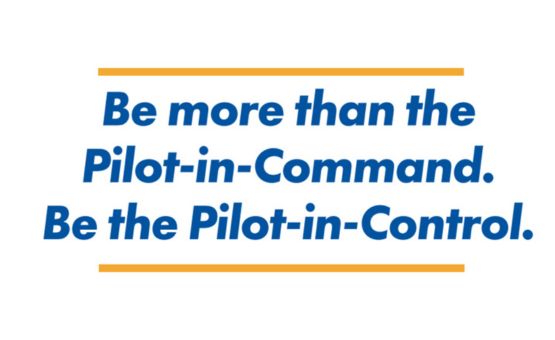
We are all familiar with the term PIC—Pilot-in-Command. It is the legal term for the person aboard the aircraft who is ultimately responsible for its operation and safety of flight. It is important to note, however, that there is a difference between being in command and being in control.
By Steven J. Daun, National Chief Pilot Just about every pilot can remember their first solo cross country flight. All of the hard work paid off and they were finally able (and allowed) to fly somewhere alone. From that time, for most pilots, planning cross country flights became rather
Holding patterns while enroute are rare indeed. You’re held for two reasons: traffic or weather. Most spacing now is accomplished through the use of speed reductions and vectors. Occasionally, holds do occur, particularly in a terminal area, so the pilot must be able to comply. What is a holding
By Steven Daun, National Chief Pilot You’ve decided to take a trip for either business or pleasure. You may be using your airplane or one that you’ve rented. Now it’s time to decide on your destination airport. Before the internet, this was a much more challenging task. Information regarding
The air route traffic control center (ARTCC) encompasses the en-route air traffic control system air/ground radio communications that provide safe, expeditious movement of aircraft operating on instrument flight rules (IFR) within the controlled airspace of the center. ARTCCs provide the central authority for issuing IFR clearances and nationwide monitoring