








By Mason Ross
Upon the completion of your training for a pilot’s certificate or rating, you are required to take an oral and practical test to obtain your desired certification. This test is most commonly given by a Designated Pilot Examiner, or DPE, authorized by the Federal Aviation Administration to provide such tests – referred to as “checkrides.” The training you receive from your instructors on the ground, in the simulator, and in the airplane prepares you to demonstrate your skills to the DPE, but there are several other factors that influence the checkride itself.
According to 2025 fiscal year data, there are approximately 1,122 active DPEs in the United States. Across the country, there were 153,967 practical tests conducted during that same fiscal year – however, of those checkrides, 75 percent were conducted by around 350 examiners. In plain terms – this means that only about a third of the DPEs in the nation administered nearly 115,475 checkrides, or 329 checkrides each, in a single year. DPEs often conduct multiple checkrides in a single day, but even if we were to assume that they only conducted one per day – the math above means that these 350 DPEs had a checkride booked almost every single day of the year.
What does this all mean? Checkride dates are tough to come by, and in high demand across the industry. It also means that as much as humanly possible, the possibility of your checkride being cancelled or postponed must be mitigated. Here are some common causes for those cancellations, and strategies to avoid them.
First, many DPEs have careers outside of their role as an examiner, such as flying for an airline or charter service, being a flight instructor themselves, or even non-aviation work. As a result, flight schools and instructors must work together with examiners to schedule checkrides for their students, requiring a great deal of coordination from both parties to do so. This can lead to long gaps between endorsement and checkride dates. Should this be the case, schedule refresher lessons with your instructor to make sure that your skills stay sharp. Also, though it is your prerogative in doing so – if your instructor or school works with several DPEs, do not become fixated on only going with one particular examiner.
Second, regardless of the best-laid plans, weather can delay or cancel a checkride altogether. The FAA mandates that DPEs only begin checkrides if there is a reasonable expectation for them to be able to complete the entire practical test. This is designed to minimize the likelihood of DPEs having long lists of discontinued checkrides, which must be completed within a 60-day window of the discontinuance, and applicants getting lost in the shuffle of these long lists. If the weather does not indicate, or show a reasonable forecast of improvement to, conditions that would allow the completion of your checkride, it may be postponed to a later date. Work closely with your instructor or flight school to secure the next available date with the DPE.
The third issue is one that is easily avoidable with proper coordination between you and the flight school – ensuring that the airplane you need is available and airworthy for the checkride. Many flight training organizations furnish the airplanes to be used during checkrides; however, it is still your responsibility as the pilot in command to ensure that airplane is airworthy for the checkride. Take time to go over the locations of the required documents and maintenance logbook entries with your instructor, and ensure that the organization providing your airplane has it reserved for the correct date and time.
Our fourth issue is one of paperwork. To take the checkride, you must have received and logged the required ground and flight training to do so. The former should be annotated in either a logbook or separate training record that specifies the knowledge areas covered and number of hours spent doing so, while the latter is kept in your logbook. Your instructor is responsible for making the correct logbook entries after each dual flight or simulator session you have with them, and signing the entries to certify them. You are responsible for ensuring that any solo flights you conduct are logged correctly, and that each logbook page is totaled and accurate. All the proper endorsements from the most current edition of Advisory Circular 61-65 are required to be present as well. Prior to arriving for your checkride, go through your logbook and mark the pages where your endorsements and major requirements such as cross-countries, night takeoffs and landings, instrument time, and solo hours are located to aid your DPE in rapidly locating them.
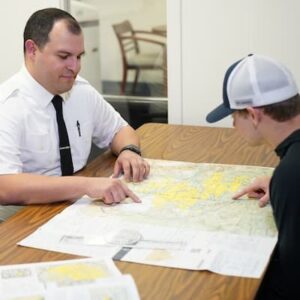
The final cause for checkride cancellations is one that falls entirely on our shoulders as applicants – our own preparedness. Not proficiency, in this case, but preparedness. DPEs have several scenarios that are used to evaluate your skills, and that will be sent to you ahead of the checkride date. These scenarios include a premise for the proposed flight, specific weight and balance calculations, flight plan routes, and performance calculations that must be completed, as well as information about the logistics of the test itself – where and when it will be, the examiner’s fee / methods of accepted payment, and other information. Pay attention to these instructions from the examiner. It is unacceptable to arrive at the checkride without your documents, the airplane’s maintenance records, a completed flight plan scenario, or the examiner’s fee – doing so can result in the cancellation of your checkride and unnecessarily prolong the acquisition of your pilot certificate or rating.
Familiarizing ourselves with the common reasons for checkride cancellations is not meant to increase the stress that inherently comes with the checkride; quite the opposite, in fact. It helps us be aware of potential issues, and just like in our flying, helps us mitigate the risks of not identifying and correcting these issues.
Blue skies, safe flying, and good luck on your checkride!