










V-speeds are the standardized language for aircraft performance and safety. These numbers, several of them marked on your airspeed indicator, cover your stall speeds, your best climb speeds, and how much the airframe can take. Your instructor will expect you to know them before your first solo. Here are the main V-speeds explained in the order you meet them: stall, climb, then structural limits.
The FAA’s Pilot’s Handbook of Aeronautical Knowledge explains these speeds, and the official abbreviations are in 14 CFR 1.2.
Stall and Flap V-Speeds Explained: Vso, Vs1, and Vfe
The lower end of your airspeed indicator shows the published stall speeds. These speeds matter most during takeoff and landing, when you are close to the ground.
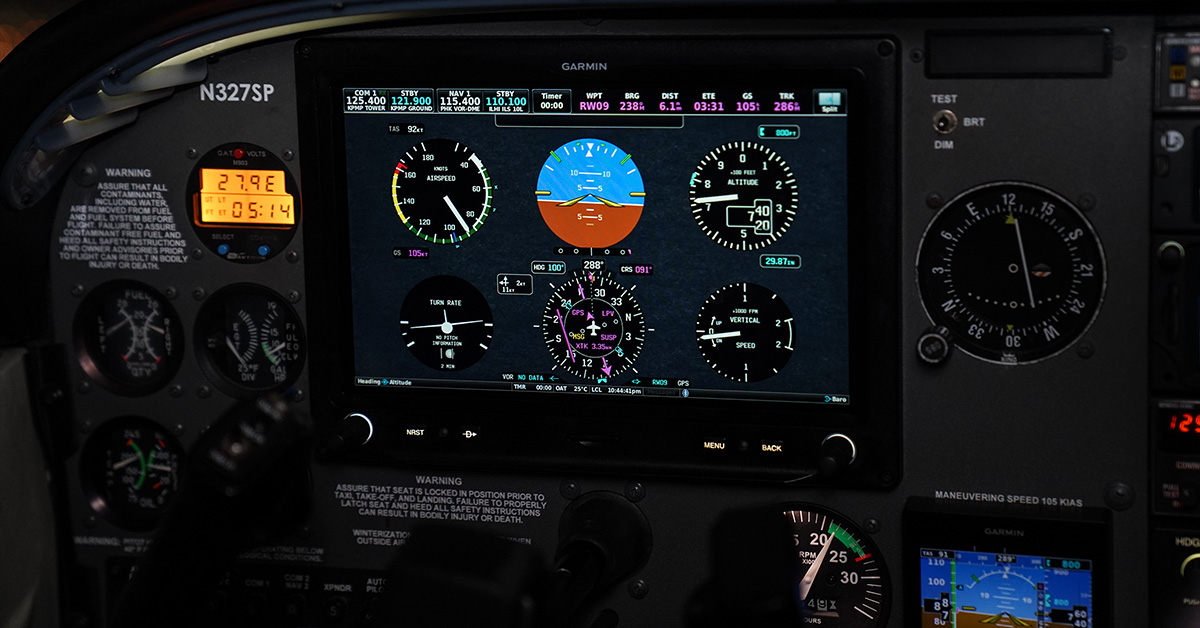
Vso is the stall speed in the landing configuration and marks the bottom of the white arc. Vs1 is the stall speed in a specified configuration, usually clean, and marks the bottom of the green arc. Flaps increase the lift coefficient of the wing, which lowers the stall speed and provides a safety margin during landing. Vfe (Maximum Flap Extended Speed) is a structural limit and marks the top of the white arc. Extending the flaps above this speed can bend or damage them. Plan your descent so you are below Vfe before the flaps come out.
Proficiency with these numbers allows you to maintain stabilized approach speeds. Stalls deserve extra study, and our discussion on stalls covers what happens when the wing quits and how to recover.
Climb Performance: Vx and Vy
Pilots frequently choose between maximizing altitude gain over distance and over time, depending on the runway and what is past the end of it.
| V-Speed | Definition | Primary Application |
|---|---|---|
| Vx | Best Angle of Climb | Maximizing altitude gain over horizontal distance; clearing obstacles. |
| Vy | Best Rate of Climb | Maximizing altitude gain over time; engine cooling and efficiency. |
| Vg | Best Glide Speed | Maximizing horizontal distance traveled per unit of altitude lost. |
| Vr | Rotation Speed | The speed at which back pressure is applied to rotate the aircraft. |
Vx gives you the most altitude over a given horizontal distance. This is your preferred speed when you need to clear obstacles immediately following takeoff. Vy is the speed for the best rate of climb, yielding the most altitude over a given period of time. This is preferred for general climbing to altitude as it allows for better forward visibility and improved engine cooling.
Linking these speeds to takeoff performance planning allows you to depart safely from short or obstructed runways.
Protecting the Airframe: Va, Vno, and Vne
Structural integrity is governed by a set of speeds that every pilot must respect to keep the airframe within design limits.
Va (Design Maneuvering Speed) changes based on the weight of the aircraft. At or below Va, you can move a single flight control to full deflection, one time, on one axis, in smooth air, without risk of damaging the airplane. It does not protect against full inputs on more than one axis or back-and-forth control movements. Va decreases as the aircraft weight decreases, and many Pilot’s Operating Handbooks (POHs) list it at maximum gross weight, so a lighter airplane has a lower Va than the book number.
The upper end of your airspeed indicator and your POH show these limits:
- Vno (Maximum Structural Cruising Speed): Defines the boundary between the green and yellow arcs. It is the maximum speed for normal operations. Operate within the yellow arc only in smooth air.
- Vne (Never Exceed Speed): Marked by a distinct red line, this is the absolute speed limit. Exceeding Vne risks structural failure and flutter.
- Vle (Maximum Landing Gear Extended Speed): For retractable-gear aircraft, this is the maximum speed at which the aircraft can be safely flown with the landing gear extended.
- Vlo (Maximum Landing Gear Operating Speed): The maximum speed at which the landing gear can be safely extended or retracted. Neither gear speed is marked as an arc. Look for them in the POH or on a placard.
In rough air, stay out of the yellow arc and slow to Va, or the turbulence penetration speed in your POH.
The Professional Path: Training and Verification
Going from student pilot to instrument-rated pilot means relying more on these numbers. Performance training becomes increasingly complex during instrument training. In instrument meteorological conditions, these numbers become primary tools for workload management and precise aircraft control.
We use a structured approach that balances ground instruction, flight simulator practice, and time in the airplane. The Electronic Flight Bag is a powerful tool, but it does not replace solid fundamentals. Pilots should always verify performance data provided by digital applications against official aircraft documents.
Learn the numbers for the airplane you fly, and know where to find them in its POH. Your American Flyers instructor will expect you to know them before you solo and on your checkride.