





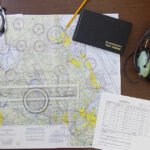
Your first flight lesson won’t start with an engine failure. It starts with a walk around the airplane and a look at the weather. That’s where aviation safety training really begins. Emergencies get the attention, but the habits you build on normal days are what keep most flights normal.
Your Safety Training Checklist for Every Flight
Under 14 CFR 91.103, you have to become familiar with all available information about a flight before you go. For any flight, that includes runway lengths and your takeoff and landing distances. Then work through this short list.
- Use the IMSAFE checklist before you leave home: illness, medication, stress, alcohol, fatigue, and emotion. If you have a cold or only slept four hours, cancel. For more on that decision, read Are You Ready to Fly?
- Check your personal minimums card, with the lowest ceiling and strongest crosswind you will accept. When the weather is close, the card makes the call.
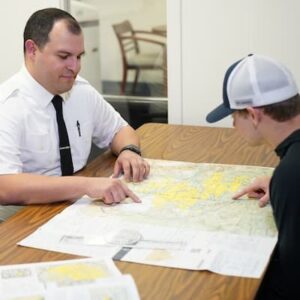
- Compare the TAF with the current METAR to see if the weather is getting better or worse. A 4,000-foot ceiling now means less if the TAF calls for 1,200 feet by the time you land. If you are still learning to read them, start with our guide to METARs and TAFs.
- Pick your turn-back point and a named airport to land at if the clouds ahead drop below your minimums.
- Ask yourself if anything is rushing you to go. Say you’re at the end of a weekend trip, and you have work Monday morning. That push to get home is the pressure to watch for.
Simulator Drills and Surprise Scenarios
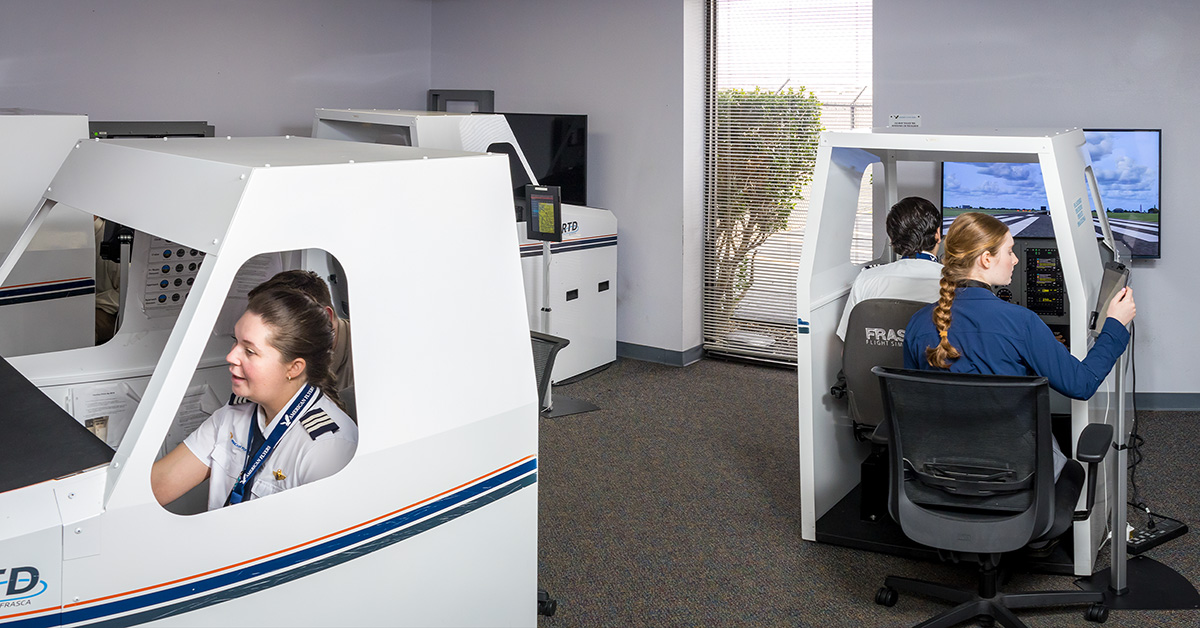
Some things are hard to practice in the airplane. An engine failure right after takeoff is one of them. In a simulator, you can fly it again and again in one session. When it happens for real, the right moves are already in your hands. Mike Bliss covers more of this in The Value of Simulators in Flight Training.
Use sim time for radio calls too. Say each call out loud until you can make it without looking down. In the airplane, that keeps your eyes outside, where the traffic is.
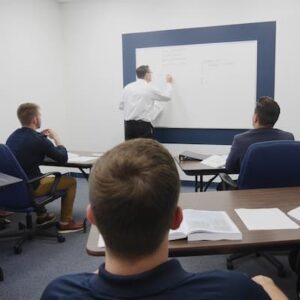
Ground school matters for the same reason. If you learn the fuel system and the airspace rules at a desk, you aren’t trying to figure them out while you fly.
Your instructor won’t always tell you what’s coming. In the pattern, they may pull the power to idle and say “engine failure.” You pick a field, set up your glide, and run the checklist. On a cross-country, they may tell you the runway ahead is closed and ask where you’re going instead.
In the sim, they can fail your attitude indicator or bring the clouds down lower than the forecast said. Either way, fly the airplane, figure out what changed, and make a plan before you talk on the radio.
After the flight, talk through when you first noticed the problem. Catching it a few seconds sooner is the skill you’re building.
Stay Ahead of the Airplane
Staying ahead of the airplane means you know your next step before you need it. Brief the landing and the go-around on downwind, before you’re busy on short final. If the approach isn’t stable, go around. A go-around costs a few minutes. Forcing a bad approach onto the runway can cost far more.
Instructors push situational awareness because you can’t fix a problem you haven’t noticed yet. These habits help you always know where you are and what is coming next:
- Every few minutes, ask yourself where you would land if the engine quit right now.
- Write down each clearance, then read it back to ATC.
- Check your position at every checkpoint. A wrong turn is easy to fix when you catch it in five minutes.
- When ATC calls out traffic near you, look where they say it is until you find it.
The FAA’s Pilot’s Handbook of Aeronautical Knowledge describes aeronautical decision-making (ADM) as “a systematic approach to the mental process used by pilots to consistently determine the best course of action in response to a given set of circumstances.” You make choices with a method instead of guessing. The preflight checklist is one way to put it to work.
If you do have a scare, go over it with your instructor while it is still fresh. Ask what you would do differently next time, and write it down.
What the Examiner Checks
In our flight training programs, we train you to the FAA Airman Certification Standards (ACS), the same standards your examiner uses on the checkride. Each task in the ACS covers what you need to know, the risks you need to manage, and the skills you need to show.
On a private pilot steep turn, you hold altitude within 100 feet, airspeed within 10 knots, and bank within 5 degrees, then roll out within 10 degrees of your entry heading. Ask your instructor which ACS tasks you’ll cover before each lesson, so you know what passing looks like.
Start using the checklist on your next flight.