







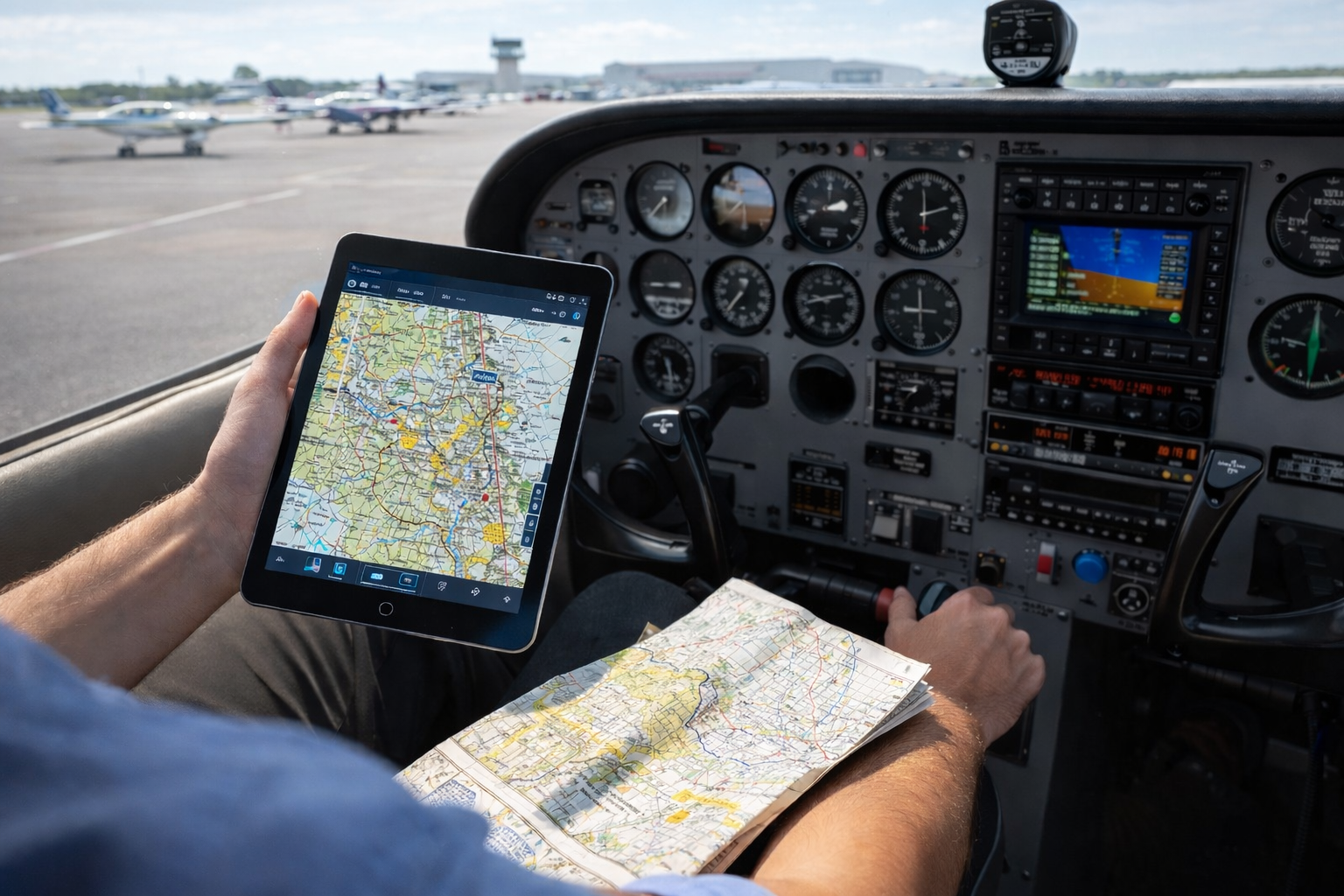





Electronic Flight Bags (EFBs) have revolutionized aviation, transforming how pilots plan flights, navigate, and access critical information. What once required a heavy flight bag full of sectional charts, approach plates, and AFD supplements now fits comfortably on a tablet weighing less than a pound. ForeFlight, Garmin Pilot, and similar applications provide real-time weather, moving maps, and instant access to every chart and publication a pilot needs. The convenience is undeniable, but it comes with a challenge: maintaining fundamental piloting skills while using modern tools.
The Reality of EFB Dependence
Today’s student pilots often complete their entire training using iPads or tablets, rarely touching a paper chart. This efficiency speeds learning and reflects modern cockpit operations. However, it can create a false sense of security. Navigating solely with GPS-driven moving maps makes reverting to pilotage and dead reckoning feel intimidating or impossible.
EFBs fail. Tablets overheat in direct sunlight, batteries drain unexpectedly, software crashes mid-flight, and screens crack. In 2024, the FAA updated Advisory Circular 91-78A to address EFB use, emphasizing their benefits while reinforcing the need for backup procedures. Pilots must be prepared to continue safe flight operations when EFB systems fail.
What Happens When Your EFB Fails Mid-Flight
Imagine this, you are on a cross-country flight when your iPad suddenly goes dark due to a dead battery, overheating, or malfunction. Your planned route, current weather, nearby airports, and approach plates all disappear. Complete dependence on the device becomes a serious problem.
While Part 91 operations in visual conditions do not require backup EFBs or paper charts, flying without them is unwise. Part 121 and 135 operations require redundant systems because technology fails. Smart general aviation pilots adopt the same mindset.
When an EFB fails, pilots must rely on fundamental skills, reading sectional charts, calculating magnetic headings, estimating groundspeed using winds aloft, and identifying landmarks through pilotage. These are not outdated skills, they remain essential in modern aviation.
Maintaining Sharp Navigation Skills
To avoid dependence, practice traditional navigation methods regularly. During training flights, put the iPad away and navigate using only paper charts and a compass. Calculate headings manually, track progress via checkpoints, and practice determining your position without GPS.
Cross-country planning reinforces these skills. Complete a full navigation log by hand, plot your course on a sectional chart, measure distances, calculate magnetic headings accounting for variation, estimate groundspeed, and determine fuel consumption. Then use your EFB to verify your work. This keeps fundamental skills sharp while still benefiting from electronic convenience.
Practice pilotage by identifying landmarks on the ground without your moving map. Look for terrain features, roads, rivers, towns, and airports, then confirm with your EFB. During instrument training, occasionally use paper approach plates instead of always displaying them electronically. Organizing and referencing paper plates develops skills that prevent helplessness if your tablet fails during an approach.
Smart EFB Usage Strategies
Effective EFB use begins with proper preflight preparation. Always ensure your device is fully charged and carry a backup power source, such as a portable battery pack. Keep your EFB out of direct sunlight to avoid overheating or position it where exposure is minimal.
Maintain current databases and charts, verifying currency before every flight. Outdated data can be worse than no electronic assistance. Consider carrying a backup device, like a smartphone with the same EFB app, for redundancy. Even a smaller screen is better than nothing.
Keep paper backups strategically available. At minimum, carry sectional charts for your route and approach plates for your destination and alternates. These provide essential backup capability without replacing electronic tools.
Building Resilient Pilot Skills
Strong pilots use technology as a tool, not a crutch. Your EFB should enhance your flying, not enable it. Enhancement means improving efficiency, situational awareness, and decision-making while maintaining the ability to operate without it. Enablement means you cannot function effectively when technology fails.
Regular training should include EFB failure scenarios. Have your instructor turn off your tablet mid-flight during a cross-country lesson and continue using only paper charts. This reveals skill gaps and builds confidence for real emergencies.
Stay proficient with manual flight planning. Even if you use an EFB for every flight, periodically complete the process by hand. Calculate weight and balance, plot courses, and determine fuel requirements without software. These exercises maintain critical thinking skills that automation can erode.
The Balanced Approach
EFBs represent genuine progress in aviation. They improve safety by providing better weather information, current charts, and enhanced situational awareness. The mistake is not using EFBs, it is relying on them exclusively.
The goal is balance, embrace technology’s advantages while maintaining fundamental skills. Treat your EFB as the primary tool but keep traditional navigation as a reliable backup. This provides the best of both worlds, modern efficiency with old-school resilience.
When your iPad inevitably fails mid-flight, you will switch to paper charts, navigate using pilotage and dead reckoning, and safely complete your flight. The most capable pilots fly as if technology will fail because sometimes it does. Master both modern and traditional skills to be prepared for any challenge in the cockpit.