





by Mike Bliss
It is as true in aviation as in any other endeavor: use the right tool for the right job. We have all used a coin as a screwdriver or a heavy wrench as a hammer, but it is no surprise that we get the best results when we use the proper tool. What may come as a surprise is that the airplane is not always the best tool for every phase of flight training.
First, we need to clarify the language the FAA uses regarding flight simulators. A true “simulator,” as defined by the FAA, refers to a multi-million dollar, aircraft-specific, full motion device. These simulators can fully replace the aircraft, and many airline pilots are type-rated without ever having flown the actual airplane.
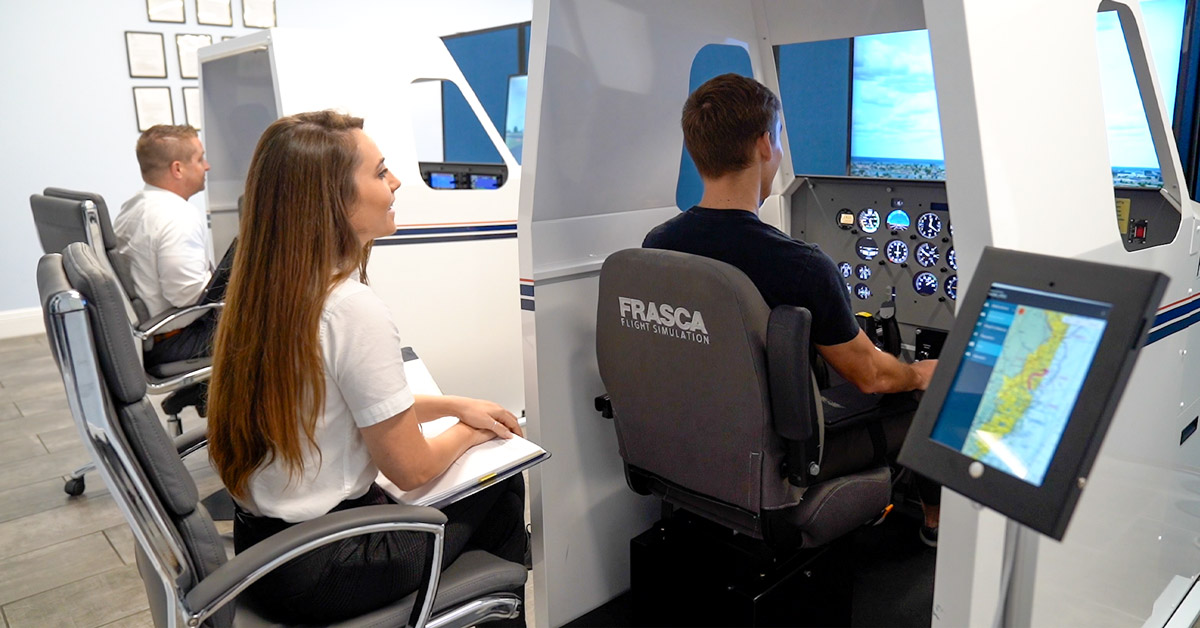
The devices most commonly used in general aviation initial training are defined by the FAA as Advanced Flight Training Devices, or AFTDs. Their purpose is not to replace the airplane, but to serve as a tool for learning the procedures required for the certificate or rating sought. In many cases, they are the most efficient way to do so. Let me offer a few examples.
While GPS and moving maps handle much of the workload, a pilot must still be able to orient themselves in relation to navigation aids or fixes if modern technology fails or when flying aircraft equipped with conventional flight instruments. With an AFTD, an instructor can reposition the “aircraft” to multiple locations and have the student determine their position relative to a navaid. Attempting to accomplish this in an airplane would only allow a fraction of the repetitions possible during a single simulator session.
Student pilots also benefit from simulator preparation before their initial solo cross-country flight. Leaving the local area for the first time can create anxiety. To ease that concern, the entire flight, or portions of it, can be practiced in the simulator before the actual flight. This allows the student to gain confidence and familiarity with the planned route.
Where an AFTD truly excels is in IFR navigation and approaches. Multiple approaches can be practiced without flying the aircraft to the initial approach fix each time. This saves significant time and allows many more repetitions within the same number of training hours. In addition, the local training environment may not offer every type of approach required for proficiency. In the simulator, instructors can select unique approaches from airports across the country, giving students exposure they otherwise would not receive.
Another major benefit is the ability to vary wind conditions. Practicing approaches with headwinds, crosswinds, and tailwinds gives students valuable experience in compensating for wind effects. If an approach includes timed segments, changing the wind conditions significantly affects timing. This adds depth and realism to instrument training.
Beyond wind, instructors can introduce turbulence and low ceilings to simulate real-world conditions. Breaking out at minimums reinforces the need to be properly configured, on speed, and in position to execute a normal descent to landing. In some training locations, students may complete their entire instrument rating without experiencing actual IFR conditions. Simulator training can provide a meaningful substitute.
Perhaps the most valuable feature of all is the ability to pause the simulator. If a student is confused or struggling, the instructor can stop the scenario and address the issue immediately. In an airplane, the instructor must either allow the student to continue in confusion and debrief later on the ground or attempt to provide instruction while the student continues flying the procedure. Many students struggle to process instructions while simultaneously managing the aircraft. The ability to pause and correct misunderstandings in real time is extremely valuable to the learning process.
The simulator is also highly effective for practicing instrument failures. In an airplane, instructors must cover a “failed” instrument, which prevents the student from recognizing the failure through observation. In the simulator, when an instrument fails, the student’s first reaction is often, “What just happened?” The student must analyze the situation, determine the failure, and decide how to respond. This is a far more realistic and valuable learning experience. Students also learn to disregard faulty indications rather than relying on an instrument that has simply been covered. If they misinterpret the clues, the instructor can pause and review the scenario.
For aircraft equipped with conventional gauges, partial panel practice in the simulator is especially beneficial. In glass cockpit aircraft, students can practice flying solely by reference to backup instruments.
When students begin multi-engine training, the simulator continues to offer significant value. Recognizing an engine failure and correctly identifying the failed engine are critical skills. The simulator allows multiple engine out scenarios in a single session without mechanical stress on actual engines. Engine failures during rotation or shortly after takeoff can also be practiced safely, without the risk associated with an improper response during actual flight.
Despite these advantages, some students have reservations about simulator training. One common objection is that the simulator does not fly like a real airplane. That is true to a degree. The simulator is a procedure trainer. Its purpose is to reinforce the procedures students must master. Most students who struggle in training or on a checkride do so not because they cannot physically fly the airplane, but because they lack procedural knowledge and proficiency. The simulator is one of the most effective tools for building that knowledge.
Another concern is the cost. Some students hesitate to spend money on training time that is not logged as actual flight. However, the simulator is significantly more economical than the airplane for the level of benefit gained. The primary goal of flight training is to become a safe and competent pilot. While building hours is necessary, accumulating hours without improving proficiency is not productive. Skills, not just time, must remain the focus.
For those pursuing an airline career, flight hours may secure an interview, but skills and knowledge secure the job.
These same principles apply when a student reaches the maximum amount of simulator time that can be credited toward a certificate or rating. The key question remains: What do I need to do to become the best pilot I can be? The answer is to use the tool that best fits the training objective.
After training thousands of pilots, we have consistently observed that students who fully embrace simulator training complete their programs in fewer hours and at lower overall cost.
All active enrolled students at American Flyers have access to unlimited scheduled simulator time.